What the constraints protect against
An options surface can look smooth while still implying impossible prices. The fit layer therefore checks the SVI smile and the surface assembled across expiries before the UI treats it as a production-quality curve.
Butterfly arbitrage checks
For each expiry, the fitted total variance smile should not imply a negative risk-neutral density. In practical terms, the engine evaluates the smile shape across a grid of log-moneyness points and publishes g-test diagnostics when local convexity or wing behavior becomes suspicious.
Calendar arbitrage checks
At the same moneyness, total variance should generally not fall as expiry increases. The surface grid and tenor rows make that check visible by comparing the fitted BTC, ETH, or altcoin smiles across maturities rather than only one expiry at a time.
Parameter sanity
The SVI parameters are bounded upstream so the fit does not solve to a mathematically legal but operationally useless shape. Typical checks cover positive variance, positive curvature scale, correlation inside its valid range, and wing slopes that remain stable enough for live monitoring.
What the Fit page shows
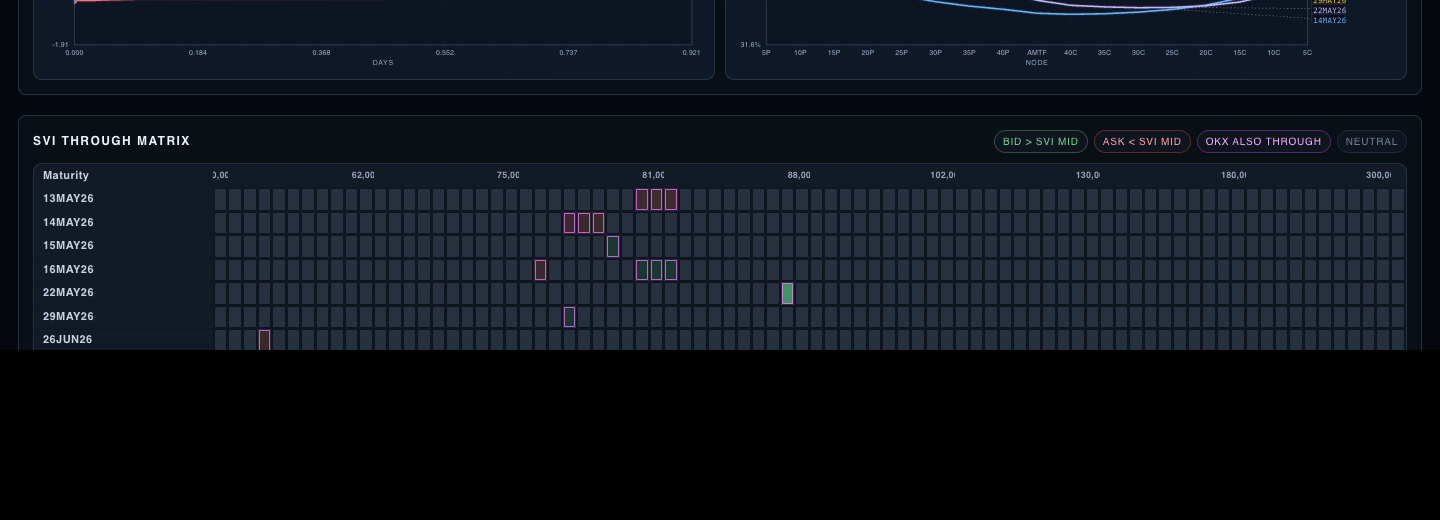
The Fit tab exposes the fitted variance curve, fitted volatility curve, 3D surface projection, and g-test panel. If the g-test view spikes or the fit error deteriorates, it is a signal to inspect the market data, stale venue overlays, or calibration inputs before relying on the surface.
Variance lines
The variance view plots total implied variance by expiry rather than annualized implied volatility. SVI is calibrated in variance space, so these lines are the native fitted objects: each line is one expiry plotted across log-moneyness. Smooth variance lines make skew, curvature, and wing behavior easier to inspect before converting the same fit back into volatility.
G-test line
The g-test view is a diagnostic series published by the upstream engine for the fitted SVI smile. It is used to monitor whether the fitted smile is drifting toward butterfly-arbitrage problems. A stable line is expected for a usable fit; spikes or sign changes should be reviewed alongside stale quotes, crossed markets, and the current fit error.