System summary
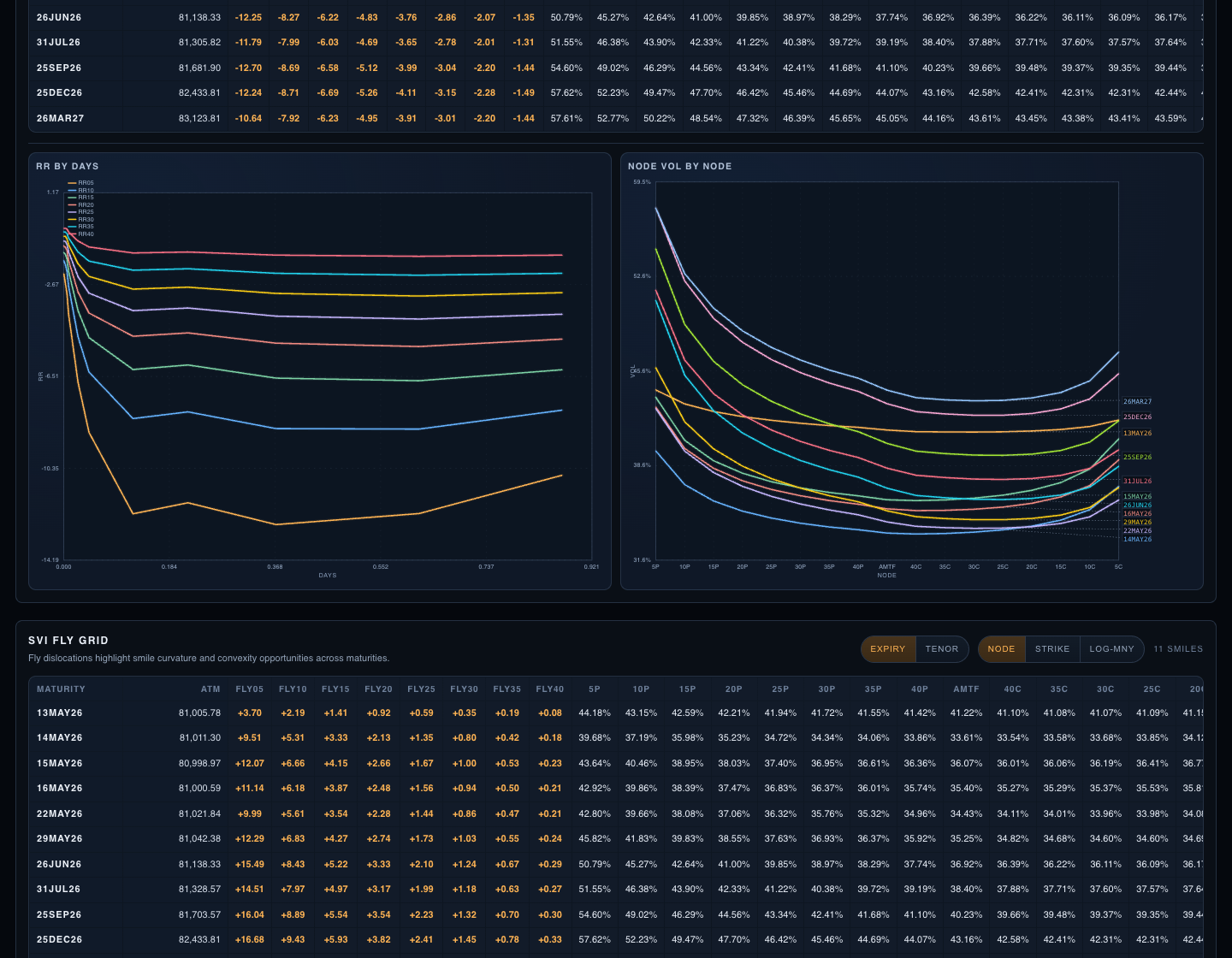
Option markets are sparse and noisy: every expiry has many strikes, each venue has its own quotes, and the useful signal is often the difference between the market and a fitted surface. DerivaSys ingests those updates, fits an SVI surface, and presents the live shape as variance, volatility, smiles, risk reversals, flies, and through-fit dislocations.
What to look at first
- Header metrics: feed state, fit objective, fit time, and latest SVI push show whether the engine is live.
- Risk reversal and fly grids: these summarize skew and curvature across maturities in trader language.
- SVI-through matrix: this shows where quoted bid/ask levels are through the fitted mid.
- Smile matrix: this compares the fitted curve with venue bid, ask, and last-trade implied vols.
- Fit tab: this exposes the surface and diagnostic views behind the market dashboard.
Why it matters
A live volatility surface is the centre of many pricing-system problems. It supports quoting, risk generation, relative-value monitoring, venue comparison, and data-quality diagnosis. The same ideas transfer beyond crypto options into rates curves, swaption surfaces, credit curves, and fixed income analytics.
What this page is not
This is not a trading ticket, investment advice, or a source of record. It is a monitoring interface for understanding the live state of a pricing and calibration workflow.